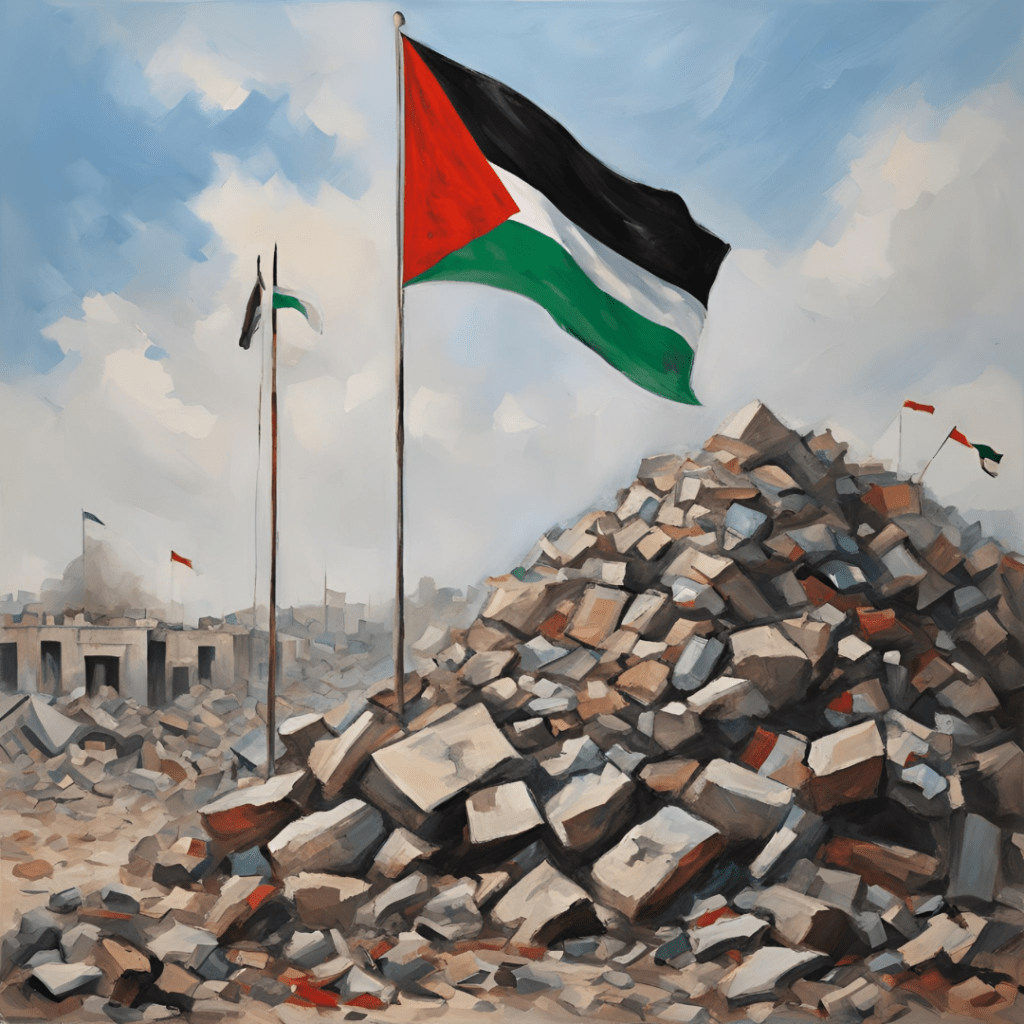
A dark cloud descended upon Maitisong Theatre as a deep engagement with the realities of the humanitarian crisis in Gaza came to light.
After a day of food, engagement, fun, and general fundraising for Palestine, the crowd gathered to hear a speech by the great award-winning journalist Youmna El-Sayed. One thing that the audience acknowledge was that it was not just a keynote address delivered by an award-winning journalist. It was a speech delivered by a mother, a wife, a resident of Gaza, a human being who has seen atrocities that were deeply drenched in inhumane action.
It is important to note that this event saw many people coming together to make it happen: Salaamedia, Zahraa-Naaz Children Fund, Voice for Palestine, Ditshwanelo, Care for Humanity and more. Zara of Voice for Palestine noted that it is easy for people to forget that “these are real people” who are in Gaza. Prof. Marobela stated that even in the midst of an apparent lack of humanity, “Humanity is still there.” She continued to ask why imperialism is not reacting to the Gaza crisis sufficiently? An intriguing question in the midst of a global debate. She also called for a “Free Palestine Movement” in Botswana.
When Youmna El-Sayed rose to the podium, the audience had been sufficiently primed. Nevertheless, the audience could have (in no way) been fully prepared for what was to come.
In order to attempt to sufficiently cover the sentiments expressed by Ms El-Sayed, I will mention major points expressed in the speech entitled “Glimpses of Life in Gaza” and then offer an analysis:
- Palestinians are forced to evacuate, yet they have nowhere to go.
- Palestinians have little to no access to shelter.
- There has been an illegal occupation and oppression of Palestine and her people by Israel, even before October 7th (the Hamas attack on Israel).
- Israel blocks travel for people in Palestine (making it difficult for them to leave).
- The Israelis view a lot of items as of dual-use which informs their prohibition of many essential items, including medical paraphernalia. This then means that Palestinians have no access to essential items.
- Children are traumatized and remember bombings while suffering physical pain without sufficient medical resources for recovery.
- Many have died, others are severely burned and injured.
- Even homes are bombed.
- A theme of “Life in Gaza” has been: Displacement, Disease, and Death.
- Morgues are full and so external morgues, without sufficient electricity supply (you can only guess what that implies).
- People are displaced from Gaza city to the South of the strip, yet bombardments are the same in the South.
On a basic level, it must be understood that the heart of the Gaza humanitarian crisis is not Arab-Israeli tensions but is a question of humanity.
Youmna El-Sayed described the humiliation of carrying an ID in one hand with a white flag in the other. Bodies of Palestinians who had been killed on that road laying in clear view of her and her family (including her young children).
“Just look straight and march.” A mother’s instruction to her children, fearing the bullets in the guns of the IDF soldiers that may have their names on them.
While she continued reporting on the ground for Al-Jazeera, she received threats from the IDF which saw her 12 year old daughter exclaiming, “We’re going to be killed because of you.”
Her 8 year old daughter, in an expression that can succinctly encapsulate the thoughts of a Palestinian child, said, “What if I stay alive?” Essentially, her fear was not death. It was surviving to face the reality of injury and the death of her family.
The hospitals in Gaza are a microcosm of life in Gaza: Hospital buildings overflowing with the sick and injured; morgues full of the dead; external morgues full of the decomposing dead; tents of people seeking shelter and refuge (with the hope that hospitals will not be bombed); and more despair.
While Benjamin Netanyahu, Israeli Prime Minister, speaks on behalf of his government, even speaking before a joint session of Congress in the United States of America, the world continues to deeply debate the matter of Israel-Palestine.
Politically speaking, it seems that the discussion is riddled with proverbial muddy waters. Youmna El-Sayed suggests that the hypocrisy of Western powers has been exposed. Their right to lecture anyone on human rights has been rescinded. Additionally, she suggests that this apparent ceasefire is for the sake of the return of hostages. Once that is achieved, they will return.
You may wonder what this has anything to do with the African person and African state. I will address this question in 3 main points: Humanity, Rebellion, and Freedom.
On the question of humanity, what is fundamentally essential is that all humans are treated as humans. That is the core of it all. Looking beyond the rhetoric, it is important to acknowledge that Palestinians deserve to be treated as humans. This is important to the African person because a colonial past unites us in that struggle of ‘sub-human’ delegation. On this front, it is an African problem. Furthermore, this then causes us to ask about the true meaning of humanity. This then allows us to progress more intentionally in our pursuit of perfect post-colonial African states. Whether it’s in South Africa, Kenya, Rwanda, or the DRC, the theme of humanity is important.
Youmna El-Sayed expressed that it would be nice to arm and allow the Palestinians to resist, especially because international law allows for resistance. The South African anti-apartheid movement is one that is celebrated worldwide. I will leave the question to the reader, “Would it be right for the Palestians to resist an allegedly apartheid-state Israel?”
In addressing freedom, we must ask what freedom truly is. Across the continent, we have seen coups against governments that were against “the people”. It must then be asked what freedom entails. Essentially, what we see as a right to freedom for the Palestinian people is a right to freedom for the African. If anything were to happen, God forbid, the African imagination must be able to encapsulate these three ideas.
Over P50 000 was raised by way of auction for the people of Palestine (the item auctioned was a cake). While the highest bidder was the High Commissioner of South Africa to Botswana at P40 000, it was an American-style auction.
Essentially, while this matter is difficult, it is important to note that it demands intense sobriety, diplomacy, and tact. I will leave it to the reader. What is the solution to this crisis? Is is a two-state solution? Is it a ceasefire? Must there be new peace talks? While there are calls to a table in Egypt, we remain with these questions. All we know is that the war must end.
 The San African
Leave a comment