Corporate South Africa faces significant underrepresentation, particularly when it comes to women in leadership positions. Despite initiatives aimed at advancing women’s rights and gender equality, the country’s business sector still lags behind. Women comprise approximately 51% of the population but only hold a small fraction of executive and managerial roles. The scarcity of women in boardrooms, C-suites and other decision-making positions is hindering the country’s economic growth as there is a lack of diversity, perspectives and experiences.
According to Just Share, women comprise 46% of the economically active population in South Africa, but hold on average 35% of board positions and only 25% of executive roles in the JSE Top 40 companies.
This underrepresentation of women in leadership positions can be attributed to a multitude of factors across various disciplines. These include:
Harmful Stereotypes
The stereotypical characteristics often associated with women hinder their progress towards higher positions in the workplace. These characteristics often include being emotional, being a homemaker, being “soft” and unable to handle tough situations. These stereotypical traits are considered as a contrast to the traits of a good leader and lead to the questioning of women as suitable leaders. In a lot of people’s eyes, women leaders are the epitome of a crumbling business.
Racism
Thirty years into democracy, South Africa’s largest population group – Black women – remain vulnerable to systemic racism and discriminatory practices. A significant challenge they face is the perpetuation of Eurocentric beauty standards, which dictate what is deemed “acceptable” in terms of hair, body, and complexion. This pervasive bias often plays out in the workplace, where black women are unfairly judged and marginalized for not conforming to unrealistic ideals, leading to a loss of opportunities.
Cultural and/or religious beliefs
Cultural and religious beliefs have historically played a significant role in limiting women’s access to leadership positions. In some societies, patriarchal norms and traditional gender roles have perpetuated the notion that women are less capable or less intelligent than men, making it difficult for them to be taken seriously as leaders. Additionally, certain religious interpretations have been used to justify restrictions on women’s participation in public life, including leadership positions. For instance, some Christian denominations, Islamic interpretations, Orthodox Jewish communities, and Hindu texts have been cited to limit women’s roles in leadership. These deeply ingrained beliefs and attitudes have contributed to the persistent underrepresentation of women in leadership positions, highlighting the need for a joint effort to challenge and change these attitudes.
Misogyny
The pervasive culture of misogyny in some South African industries can have a profound impact on women’s career advancement and overall well-being. When women are subjected to discriminatory attitudes and biased practices, it can lead to a lack of confidence and self-doubt, making it even more difficult for them to break through the glass ceiling. Furthermore, misogyny can also lead to a lack of representation and voice for women in leadership positions, perpetuating a cycle of exclusion and marginalization. The carrying out of misogyny to women might discourage them from entering into these spaces. Ultimately, addressing misogyny is crucial to creating a more inclusive and equitable environment for women in leadership positions in South Africa.
The lack of representation of women in leadership positions has a ripple effect where young women and girl children do not see themselves in these environments and therefore deem them places not for people like them. Economic growth of the country is then limited because people who might have been exceptional leaders and founded exceptional businesses, never get to realize their potential and true skills.
Although there is no single theory that directly explains the correlation between women leaders and stock market perfomance, there is no doubt that the different perspectives brought by women will propel companies and economies forward.
The issue of underrepresentation of women in leadership positions goes beyond JSE listed companies. Every year, the people of the country are shown how the country is crumbling under the hands of leaders, most of which are men, but there has been no joint effort to put more female leaders and have more female led parties in parliament. A gender proportional government, along with other factors such as more youth inclusivity might be just what the country needs to thrive.
In conclusion, women leaders bring unique perspectives and approaches to problem solving, which can lead to more innovative and effective solutions. Due to the things that women may face on a daily basis, the claims that women are weak are really just baseless accusations founded on the principles of misogyny.
According to the World Economic Forum, accelerating progress towards gender parity will not only improve outcomes for women and girls but benefit economies and societies more widely, reviving growth, boosting innovation and increasing resilience.
Author: Pheliswa
-
Freedom: When Emulating the Oppressor Becomes the Ultimate Goal
“The sad thing is that many of the people, including those who were previously in exile, equate freedom with having a white neighbor. They are obsessed with being whites and living up to their standards.”
These poignant words of South African author, Sandile Memela from his book, “Flowers of the Nation”, remind us that the concept of freedom can easily be distorted. For many, freedom is not about self-determination, cultural pride, or community togetherness. Instead, it has become synonymous with the assimilation into the previously dominant culture.
This phenomenon is not only present in South Africa, as it is common in many post-colonial societies. The legacy of colonialism and apartheid has left deep-rooted scars, perpetuating a mindset that equates whiteness with superiority. A lot of Africans have, unknowingly or knowingly bought into the lie that whiteness is the epitome of success, sophistication, and civilization.
The author’s statement highlights the tragic irony of this situation. Many individuals, including those who were in exile or those who were marginalized, now measure their freedom and success by their proximity to whiteness. They seek to live in affluent neighborhoods, send their kids to predominantly white schools, fluently speak the oppressor’s language, often at the expense of their indigenous languages.
This reality shows that colonialism was more than just the land or the resources, it was internalized.
How then can we claim to have finally gained victory when our cultures, languages and identities are slowly diminishing, some of the very things our liberators fought for?
However, others may argue that those who choose to abandon their heritage cannot be blamed as the lives of African indigenous people, years into democracy, show little to no improvement. A continent where majority of low-income families are the indigenous people. A continent where those with the least job opportunities are the indigenous people. A continent where those with the most disparities in access to education…are the indigenous people. Based on a 2015 study, South African white households, where the head is a high school dropout, have a higher net worth than black households where the head has a college degree (Hamiltion et al. 2015). “The typical black household owns 5 per cent of the wealth held by the typical white household.” In Zimbabwe, many believe that the reason for the country’s economic decline is former President Robert Mugabe’s decision to force white farmers to give up their farms in 2000. African public schools which predominantly serve indigenous kids, lack the necessary facilities to discover and unearth the diverse talents of school kids. In the Gini Index of countries with the biggest inequality in income distribution 2023, African countries dominated the top spots, with South Africa topping the list with a Gini score of 63. Namibia followed in second place, with many African countries such as The Kingdom of Eswatini, Botswana, Zambia, Angola, Mozambique and Zimbabwe all in the top 10.
So, how can people who choose to abandon their heritage, their history be blamed when decades into democracy, African indigenous people are still at the bottom of the list in terms of wealth? After all, one of the biggest manipulations that colonialism enforced in African people is the belief that their cultures, identities, languages and religions are inferior and do not fit anywhere on the success ladder.
A mindset that needs to be instilled in the minds of Africans is one that knows that they do not need to reject their heritage in order to fit into society. There is nothing wrong with wanting better education, better opportunities and an affluent lifestyle, while being proud of your identity. After all, it is written nowhere that certain groups of people need to suffer while others get all the benefits earth has to offer. Nowhere is it written that financial security, erudition, comfort, are reserved for specific individuals.
While there is still a long way to go before freedom can fully be claimed in African nations, there are individuals who try to decolonize the minds of people. There are countless authors, teachers, activists, businesspeople et cetera, who teach the importance of maintaining our heritage. Some examples include Dr. Eileen Elizabeth Pooe, a lecturer at North West University who made history as the first doctor of philosophy in languages and literature, in Setswana, Penina Muhando, a Tanzanian playwright whose plays are available only in Kiswahili, amongst many others. There are many unknown individuals who are trying to stay true to their identities by either reading in African languages, wearing African textiles and designs, or speaking out against injustices affecting African communities.
An assimilationist mindset takes away our unique perspectives, our priceless values and our beautiful traditions. It takes away the very things that make Africa, Africa and Africans, Africans.
Ultimately, true freedom is not about emulating the oppressor; it is about embracing and celebrating one’s own heritage and striving for success without sacrificing these. As Sandile Memela’s quote so poignantly reminds us, it is time to redefine what freedom means and to reclaim our rightful place as proud, dignified, and self-determined individuals.
Chelwa, G., Maboshe, M., & Hamilton, D. (2024). The Racial Wealth Gap in South Africa and the United States. Review of Political Economy, 36(2), 423–440. https://doi.org/10.1080/09538259.2024.2318962
Dyvik, E.H. (2024). Gini Index- countries with the biggest inequality in income distribution 2023. Statista. Retrieved January 20, 2024, from https://www.statista.com/statistics/264627/ranking-of-the-20-countries-with-the-biggest-inequality-in-income-distribution/Memela, S. (2005). _Flowers of the Nation_ . University of KwaZulu-Natal Press.
-

The Importance of Preparing African Children for an AI-driven Future
As the world moves towards an Artficial Intelligence and technology driven future, Africa’s next generation needs to be equipped with the skills to thrive in this new landscape. In order for the people and the continent to progress, preparation is essential otherwise we risk being left behind.
AI has proven the risks it comes with, both for intellectual and interpersonal skills, so counteracting these risks before they perpetuate into something beyond repairable is essential. If PhD students can be expelled, writers questioned, what can stop children, who view AI as a seemingly harmless tool, from requesting AI to solve mathematics problems, generate English essays and do their homework while their brains slowly diminish and their critical thinking skills never constructed. What makes AI more dangerous is not the fact that it does these things, it is the fact that it can be told to “write this essay as an eight year-old”, undermining not just critical thinking, but creativity as well.
Research has shown that AI may not be all bad for children, as it has become a tool used to seek advice, perhaps preventing many may-have-been suicides or murderers. AI is also used to fill the curiosity gap by replying to questions many adults may have shushed away or blatantly ignored. Whether one likes or does not like AI, whether the negatives outweigh the positives, the fact that it has become a tool present all around us, almost unavoidable, rings true.
An immense amount of data is used to train Artificial Intelligence systems. Data retrieved from books, articles, the internet and in cases where these are limited, synthetic data manufactured by companies. A lot of ongoing debate and research about the racial and cultural bias undertaken when ‘feeding’ these systems is currently a popular topic among scientists, specifically black scientists who are among those who will be greatly affected. This poses a huge amount of risk for black children who are future employees, as these systems favour their white counterparts over them. As names are part of what is used to filter through CVs, the situation is exacerbated in Africa where most of our names are in African languages which is foreign to these systems.Stefan Milne writes in a UW News article about new University of Washington research that found significant racial, gender and intersectional bias in how three state-of-the-art large language models, or LLMs, ranked resumes. The researchers varied names associated with white and black men and women across over 550 real-world resumes and found LLMs favoured white-associated names 85% of the time, female associated names only 11% of the time, and never favoured black male-associated names over white-male associated names. This is alarming for the future of African youth and ought not be taken lightly.
The fact that Africa is often overlooked where issues of innovation and technology are concerned, is the more reason why we should prepare ourselves and future generations for an AI-driven world. Alternative ways have to be considered and created as the job market seems bleak for black people in an AI-driven future.
African children and youth have to be taught about the concept, opportunities and dangers of Artificial Intelligence. They have to be well informed on how the developments of these systems prejudices them so they can be prompted to possibly start thinking of solutions. African future generations have to be taught on the uses of AI, and how they can utilize these systems to advance their communities, businesses and countries.
Many African children are unaware of the vast careers that are in the fields of science and technology. There has to be programs or ways where school kids are not only encouraged to study science, but are introduced to the various careers, beyond engineering and medicine, that are in the field.
African classrooms have to do away with notebooks and papers as a way of writing notes or assessing knowledge. When a normal school-aged child does not know how to turn on a computer, or what Word is, how is she or he expected to survive in a world where almost everything is going digital? Classrooms have to be up-to-date with the 21st century developments so that children can have the required skills and knowledge of digital tools and equipment.
Children and youth have to be taught on what to discuss and what not to discuss with AI tools, as these tools are still digital and privacy within the digital world is questionable.
Beyond the technical skills required for this new landscape, it has become crucial for African children to develop soft skills. Some of the most important soft skills are critical thinking, creativity, communication, problem-solving and empathy. These are crucial to both retain individuality as humans, and to ensure that relations between each other is not lost.
Some of the ways to teach soft skills to African youth are:
Reading
A journal article by P Matthijs Bal and Martijn Veltkamp of the National Library of Medicine is quoted as stating “According to Oatley, fiction presents a simulation of real-world problems, and therefore has real consequences for the reader. Often when someone reads a fictional story, identification with the characters in the story causes the reader to sympathize with the characters, and perhaps even experience the events in the story as if the reader experiences the events him-/herself. Consequently, the reader practices being empathic while reading a fictional story.” Reading not only builds empathy, but it stimulates imagination, leading to the building of creativity.
Activities excluding AI
Children have to be introduced to problem-solving activities where the use of AI is prohibited. This is so that they can be allowed the opportunity to think critically in order to come up with their own unique solutions, building their critical thinking, problem-solving and creativity skills in the process.
Group work
Whether at home or in classrooms, activities where children are required to work as groups is essential in order to build communication skills. Activities such as sports activities, classroom activities or games and chores at home are examples of such activities where communication can be built.
In conclusion, preparing African Children for an AI-driven future is non-negotiable and requires a multi-faceted approach. This involves teaching them about AI, updating classrooms to reflect the digital age, and developing essential soft skills. By doing so, we can ensure that African children are equipped to thrive in an AI-driven world and contribute to the continent’s growth and development.
References
Bal, P. M., & Veltkamp, M. (2013). How does fiction reading influence empathy? An experimental investigation on the role of emotional transportation. PloS one, 8(1), e55341. https://doi.org/10.1371/journal.pone.0055341
Milne, S. (2024, October 31). AI tools show biases in ranking job applicants’ names according to perceived race and gender. UW News. -
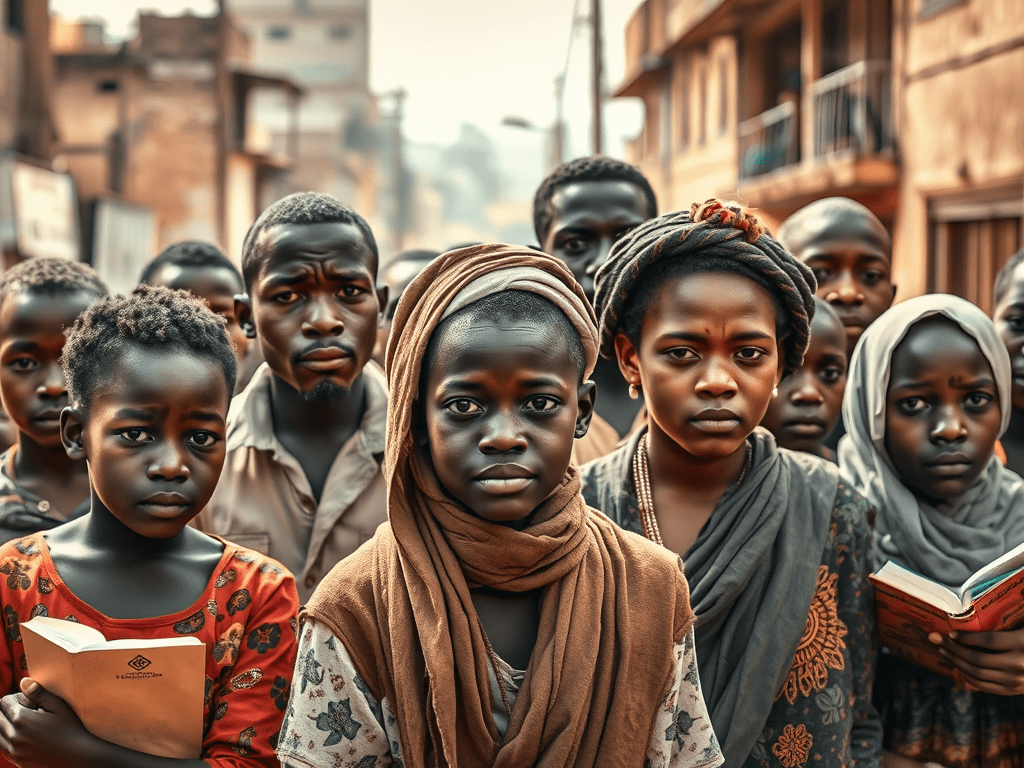
Poverty in Africa: Understanding the Causes and Impacts
Poverty is a pervasive and complex issue that affects millions of households in Africa. Despite multiple initiatives directed at reducing poverty, many Africans still struggle to access basic necessities like water, food, housing, healthcare and education. Statistics by the World Bank reveal that in 2024, Sub-Saharan Africa accounted for 16 percent of the world’s population, but 67 percent of the people living in extreme poverty. Furthermore, two thirds of the world’s population living in extreme poverty live in Sub-Saharan Africa. In this article, we will delve into the causes and consequences of poverty in Africa in order to gain understanding.
Poverty in Africa stems from a combination of multiple factors including historical, political, social and economic factors.
The most widely recognized key cause of poverty in Africa is colonialism. The colonial era disrupted many traditional African economies and exploited many African indigenous people. Colonialist countries took control of many African natural resources. The effects are still felt today where some of the biggest companies operating in Africa are owned by descendents of colonialists, particularly in the natural resources sectors. Indigenous people of African countries are still being exploited by these companies which prioritize profit over the livelihoods of people. Other countries benefit more from Africa’s own natural resources than the continent itself.
Another key cause of poverty in Africa is the lack of access to education. A huge population of Africans remain uneducated, with the recent Covid pandemic having exacerbated the situation. This leads to a lack of skills and knowledge required in the workplace, therefore rendering people unable to secure good-paying jobs to improve living conditions. Governments end up outsourcing skills, further reducing employment opportunities for indigenous people. The inaccessibility to schooling and libraries reduces critical thinking and imagination skills, therefore lowering entrepreneurial ideas and opportunities.
Economic instability across the world is another factor which contributes to the poverty in Africa. Wars between countries, political elections and natural disasters in other countries affect African national economies. Investments decline and local businesses suffer, amongst other issues caused by economic instability.
The last key contributor to poverty is corruption and poor governance at national level and by business leadership. Funds meant to benefit communities are often misappropriated by those in power, who use them for their own selfish interests. This leads to low quality infrastructure, endangering the lives of the people. Finding employment or securing government contracts has also become increasingly challenging. Nepotism has become a dominant factor, where landing these opportunities is no longer based on merit, skills or education, but rather on personal connections or relationships. The job market has become a “who you know” world.
Other factors which contribute to poverty include cultural ideologies, patriarchy, and illness, among others.The impacts of poverty on African communities are devastating and far-reaching. To break this continued cycle of poverty, governments, leaders, communities and individuals have to work together to address the root causes of poverty, invest in human development and economic empowerment and create sustainable and inclusive environments.
The narrative told by generations to come has to be one of triumph, progress and prosperity.
Citations
World Bank. 2024. _Poverty, Prosperity and Planet Report 2024: Pathways Out of the Polycrisis._ Washington, DC: World Bank.
 The San African