Category: Culture & Politics

  • Poverty in Africa: Understanding the Causes and Impacts

    Poverty in Africa: Understanding the Causes and Impacts

    Poverty is a pervasive and complex issue that affects millions of households in Africa. Despite multiple initiatives directed at reducing poverty, many Africans still struggle to access basic necessities like water, food, housing, healthcare and education. Statistics by the World Bank reveal that in 2024, Sub-Saharan Africa accounted for 16 percent of the world’s population, but 67 percent of the people living in extreme poverty. Furthermore, two thirds of the world’s population living in extreme poverty live in Sub-Saharan Africa. In this article, we will delve into the causes and consequences of poverty in Africa in order to gain understanding.

    Poverty in Africa stems from a combination of multiple factors including historical, political, social and economic factors.

    The most widely recognized key cause of poverty in Africa is colonialism. The colonial era disrupted many traditional African economies and exploited many African indigenous people. Colonialist countries took control of many African natural resources. The effects are still felt today where some of the biggest companies operating in Africa are owned by descendents of colonialists, particularly in the natural resources sectors. Indigenous people of African countries are still being exploited by these companies which prioritize profit over the livelihoods of people. Other countries benefit more from Africa’s own natural resources than the continent itself.

    Another key cause of poverty in Africa is the lack of access to education. A huge population of Africans remain uneducated, with the recent Covid pandemic having exacerbated the situation. This leads to a lack of skills and knowledge required in the workplace, therefore rendering people unable to secure good-paying jobs to improve living conditions. Governments end up outsourcing skills, further reducing employment opportunities for indigenous people. The inaccessibility to schooling and libraries reduces critical thinking and imagination skills, therefore lowering entrepreneurial ideas and opportunities.

    Economic instability across the world is another factor which contributes to the poverty in Africa. Wars between countries, political elections and natural disasters in other countries affect African national economies. Investments decline and local businesses suffer, amongst other issues caused by economic instability.

    The last key contributor to poverty is corruption and poor governance at national level and by business leadership. Funds meant to benefit communities are often misappropriated by those in power, who use them for their own selfish interests. This leads to low quality infrastructure, endangering the lives of the people. Finding employment or securing government contracts has also become increasingly challenging. Nepotism has become a dominant factor, where landing these opportunities is no longer based on merit, skills or education, but rather on personal connections or relationships. The job market has become a “who you know” world.

    Other factors which contribute to poverty include cultural ideologies, patriarchy, and illness, among others.

    The impacts of poverty on African communities are devastating and far-reaching. To break this continued cycle of poverty, governments, leaders, communities and individuals have to work together to address the root causes of poverty, invest in human development and economic empowerment and create sustainable and inclusive environments.

    The narrative told by generations to come has to be one of triumph, progress and prosperity.

    Citations
    World Bank. 2024. _Poverty, Prosperity and Planet Report 2024: Pathways Out of the Polycrisis._ Washington, DC: World Bank.

  • THE SILENCE OF THE LAW: WHEN THE COURTS FAIL TO REFLECT THE MORAL CONCIOUS OF THE PEOPLE

    THE SILENCE OF THE LAW: WHEN THE COURTS FAIL TO REFLECT THE MORAL CONCIOUS OF THE PEOPLE

    By tlotlego abram

    INTRODUCTION

    President Advocate Duma Boko’s overturning of the court’s judgements must not be misinterpreted as an act of undermining the concept of the rule of law in favour of political expediency but an act, ethical, morally righteous in its nature and in all existing structures of objective and validity assessment, necessitated by a restoration of human dignity and cultural continuance.  His assertions by record of his first state of nation address say:

    “10th of December 2024 the body of Pitseng Gaoberekwe will be buried in the central Kalahari game reserve. His ancestral Home. Your government that under color of court judgements denied him dignity of a burial in his ancestral land has now taken the bold step of abandoning all those judgements and burying him. In this ceaseless quest to uphold dignity we are unshakeable.”

    This utterance, with his voice reverberating from within the echoic parliamentary chambers to the Gaoberekwe family and the nation of Botswana was a message that held the weight of a promise fulfilled. It preconized that Gaborekwe, once held hostage by the sterile chambers of legality given to the mortuary to imprison for two years, will be laid to rest in the ancestral heartland of his clan on world Human Rights Day. This is no ordinary arbitrament. This article explores the failure of the courts to reflect the moral conscious of the people.

    Historical context

    Basarwa encountered, for centuries, marginalization and dispossession, with their deportation from the Central Kalahari Game Reserve standing as an emblem of injustice. Its establishment of 1961 was initially mandated for the protection of the indigenous way of life and the region’s unique multifariousness. However, policies by government prioritised development and resource preservation with an ultimate outcome of Basarwa being displaced. This removal severed their spiritual and cultural ties to the land, reducing their central land to “just but” a geographic entity controlled by the states policy. This historical excursion makes providence of context by which we can view the recent burial dispute.

    Futher Thought  

    It would seem, in this controversial happening between “rights” older than the laws themselves, presents two factors to be in contradiction, the rigidity of legal frames works and the moral imperative of justice. The question that challenges the silence of the law in its failure to reflect the moral conscience of the people is this, should the law continue to uphold rigidity when it conflicts the moral conscience of the people, in this case Basarwa? How does the law serve justice when its processes seem to outpace the very lives it is meant to protect?

    It is an unchallengeable truth that laws are meant to apply equally to all though when divorced from their social and historical contexts they reinforce existing disparities. In this particular matter, the courts, constitutionally so, may have acted in accordance with statutes documents governing land use and burial rights, but this rigid adherence to the law, without mercy and consideration of cultural moral obligations denied the family their deeper and more profound entitlement, the very right to cultural continuity and dignity. By refusing to consider the broader implications of their ruling, the courts treated the law as an end in itself, rather than the vey platform for the realisation of justice. This legal formalism becomes especially and highly problematic when dealing with marginalized communities whose historical dispossession was itself codified by earlier legal frameworks.

    If the law is indeed a social fact with a moral intuition, it means by its primary mandate, while it is to invoke and sustain order, its goal is to be a healer of conflict. However, the invocation of order is in the accommodation of societal values which regulate human life. Therefore, to some extent, the courts in reflecting on the moral conscious of the people, might have to find themselves dematerialising their legal systems to stimulate representation of the moral and spiritual obligation established as the necessary end derived from the necessary act of allowing the burial.

    Conclusion

    It is with this declaration, that Advocate Boko sets in motion a historic act of restitution, one that challenges not court judgements but the very foundation and thought of how justice is perceived in Botswana. The relation of morality to law is unquestionable and therefore all laws, especially those that invoke conversations such as those of moral obligations must be subjected to moral scrutiny. Justice is in its nature a moral concept which is meaningless outside the area of morality.

  • Charting Horizons: Reimagining University Education in Botswana for a Just and Prosperous Future

    Charting Horizons: Reimagining University Education in Botswana for a Just and Prosperous Future

    by Teedzani thapelo

    On October 30, 2024, Botswana witnessed a seismic political shift as the Umbrella for Democratic Change (UDC) emerged victorious in a historic landslide victory. The electorate, driven by aspirations for decent jobs, high wages, and equitable opportunities, entrusted UDC with the mandate to transform Botswana into a nation where human dignity is not merely a slogan but a lived reality.

    In this new era, the place of university education as a catalyst for socioeconomic reform is undeniable. But the question lingers: how can Botswana’s higher education system be recalibrated to equip citizens for a turbulent, crisis-ridden global landscape?

    Decent Jobs and Human Dignity: A Call for Change

    The UDC’s campaign trail resonated with the cry for decent jobs and equitable wages—a message that struck a deep chord in a country where many graduates face the stark reality of unemployment or precarious work.

    University education, traditionally seen as a pathway to personal and societal advancement, is at risk of losing its relevance if it cannot adapt to the demands of a 21st-century economy.

    To meet these challenges, Botswana must reconceive its higher education framework as a dynamic engine that not only prepares students for the jobs of today but anticipates the work of tomorrow.

    Technological Horizon

    We live in an age of relentless technological progress, where artificial intelligence, automation, and digitalization are reshaping industries. For Botswana, this presents both a challenge and an opportunity. The challenge lies in ensuring that its universities remain at the cutting edge of technological innovation, producing graduates who can thrive in a digital-first world.

    The opportunity lies in leveraging technology to solve pressing local problems, from optimizing water usage to developing AI-driven agricultural systems. The appointment of Prince Maele, with his background in human resources, as the Minister of Higher Education signals an intent to align university curricula with these emerging technological realities.

    Approach to Crisis Preparedness

    The 21st century is a century of crises—climate change, pandemics, economic inequality, and political instability. These existential threats demand thinkers and doers who can transcend traditional academic silos. Botswana’s universities must embrace multidisciplinary and intersectional approaches, combining fields such as environmental science, public health, economics, and the humanities. For instance, preparing students to tackle climate change might require integrating indigenous ecological knowledge with cutting-edge scientific research, fostering innovation that is both globally informed and locally relevant.

    Education for Distributive Justice

    At the heart of UDC’s vision is the principle of distributive justice: the fair allocation of resources and opportunities across society. Higher education must embody this principle, ensuring that access is not confined to an elite few but extended to all capable and deserving individuals.

    This requires a robust investment in intellectual infrastructure, and targeted initiatives to uplift students from marginalized communities.

    Moreover, it calls for a shift in mindset, valuing vocational and technical training alongside traditional academic pathways, so that every learner’s potential can find expression in a diverse economy.

    From Degree Holders to Problem Solvers

    Botswana’s universities must move beyond producing degree holders to nurturing problem solvers—individuals who can think critically, innovate creatively, and act decisively.

    This requires a pedagogical shift, emphasizing experiential learning, internships, and community-based projects. By engaging with real-world challenges, students can develop the skills and resilience needed to navigate an uncertain future. For instance, students in engineering could work on designing sustainable housing for flood-prone areas, while those in the arts could create campaigns addressing public health issues.

    Fostering Intellectual Independence

    The role of higher education extends beyond preparing students for employment; it must also cultivate intellectual independence. Universities should be spaces where students grapple with complex ideas, challenge societal norms, and envision alternative futures.

    This is particularly vital in Botswana, where the dominance of a single political party for decades has left a legacy of limited ideological plurality. Under UDC’s leadership, universities must become crucibles of free thought, nurturing a new generation of thinkers and leaders committed to justice and progress.

    Global Competence, Local Roots

    While Botswana’s higher education system must prepare students for global competition, it must also remain deeply rooted in local realities. This means prioritizing research that addresses Botswana’s unique challenges, from water scarcity to wildlife conservation, while fostering a sense of national identity and pride. Collaboration with international institutions can bring in fresh perspectives and resources, but the ultimate goal should be to build a self-reliant and resilient intellectual ecosystem.

    Leadership and Policy

    Transforming university education requires visionary leadership and coherent policy frameworks. The new administration under Duma Boko must invest in higher education as a strategic priority, with clear benchmarks for success.

    This includes increasing funding for research and development, incentivizing public-private partnerships, and ensuring that universities are accountable to both students and society. Prince Maele’s appointment as Higher Education Minister is a promising start, but the task ahead is monumental and requires a collective effort.

    Toward a Shared Intellectual Future

    As Botswana stands on the brink of a new chapter, its universities must rise to the occasion, becoming beacons of hope and engines of transformation. They must inspire not only confidence in their graduates but also a sense of shared purpose in the broader society.

    The vision of a just, prosperous, and equitable Botswana will remain elusive unless higher education is at its heart, shaping citizens who are equipped not only to succeed but to uplift others in the process.

    The UDC’s victory has created a unique opportunity to rethink and rebuild Botswana’s education system for the 21st century.

    The question now is whether we can muster the courage, imagination, and determination to seize this moment.

    If we do, we may yet chart horizons where knowledge, dignity, and justice light the way to a better future for all.

  • Great Expectations…

    Great Expectations…

    by Teedzani Thapelo

    The winds of October came thick with dust and whispers, stirring the vast grasslands and city streets of Botswana into a trembling anticipation. On the 30th of this momentous month in 2024, the unexpected became real, and the ground beneath the nation shifted like the Kalahari dunes under a gale.

    The Umbrella for Democratic Change (UDC), long seen as a mere shadow cast by the towering Botswana Democratic Party (BDP), claimed an electoral triumph that stunned even its most loyal followers. It was as though the sky itself had cracked open, spilling light into corners darkened by decades of political dominance.

    The Botswana Democratic Party, which for over half a century had ruled with an unbroken chain of victories, faced its reckoning. Like the mighty baobab that stands tall until termites hollow its core, the BDP fell not to foreign invaders or natural disasters, but to the quiet erosion of trust, the muffled cries of the people, and the weight of its own hubris.

    To many, it seemed a twist of fate worthy of African folklore—an epic tale where the once-untouchable leader is humbled by forces beyond his grasp, forces rooted in the will of the people.

    The UDC’s triumph, led by the determined Duma Boko, was not a mere accident of politics; it was the manifestation of democracy’s unpredictable brilliance. It was a moment when the chorus of the nation’s grievances—jobs lost, hospitals crumbling, schools faltering—rose so loud that even the thick walls of power could not muffle them.

    Yet, as the victory drums faded, a sobering question emerged: What now?

    This political earthquake has ushered Botswana into what many are calling its Second Republic—a term that evokes hope, renewal, and the promise of change. But with it comes a burden: the weight of the people’s “great expectations.”

    The UDC now finds itself standing at the edge of a precipice, gazing into a future both promising and perilous.

    The challenges are staggering.

    Public hospitals, once beacons of care in southern Africa, are now shadows of their former selves. The sick wait in lines that stretch like cattle paths, while medicines remain locked away in bureaucratic tangles. Corruption, like a termite infestation, has weakened the once-strong beams of public institutions. And the economy, battered by global shifts and internal neglect, limps like a wounded antelope.

    Boko, a man who has long promised change, must now deliver. The people demand an end to empty speeches and half-measures. The UDC must overhaul public services with a precision that cuts through decades of inefficiency.

    But how?

    The answer lies not just in plans and policies, but in the deep well of hope that propelled the UDC to power.

    Here, the surrealist dimensions of this moment become clear. Who could have imagined that in a nation so deeply shaped by the BDP’s legacy, the people would rise to reject it? It is as though an unseen hand guided their will, a hand that does not care for titles or traditions, but only for justice. In this sense, the UDC’s victory feels like a dream—unreal yet undeniably true.

    The new government must not squander this rare gift. Botswana, a land of vast skies and resilient people, deserves leaders who see beyond personal gain. The UDC must set its sights on the long game, crafting a vision that lifts the nation out of its current malaise and into a future of shared prosperity. They must listen to the farmers who toil under an unforgiving sun, the miners who dig deep into the earth for wealth they seldom share, and the youth whose futures feel as uncertain as the rains.

    As the first rains of November break over the land, washing away the dust of the election, there is a sense of renewal in the air. The people are watching, waiting, their faith both fragile and fierce.

    The UDC has been handed not just a mandate, but a mission—a chance to prove that democracy in Botswana is alive and well, capable of reinventing itself when the old ways fail.

    But with great expectations comes great responsibility. Boko and his team must remember that the story of Botswana is not theirs alone to write. It belongs to the nurses who save lives with too few resources, the teachers who inspire despite broken chalkboards, the mothers who walk miles to fetch water.

    These are the real heroes of the Second Republic, and it is for them that the UDC must govern.

    In the years to come, historians may look back on this election as a turning point—a moment when the people, weary of the old ways, reached for something new. Whether the UDC rises to meet this moment or falls under its weight remains to be seen. But one thing is clear: Botswana’s journey has entered a new chapter, one filled with uncertainty and promise in equal measure.

    The land waits, as it always has, for the rains to bring life to its parched soil. And the people wait, too, for their new leaders to nurture the seeds of hope they have sown. It is a delicate dance between expectation and reality, between dreams and deeds.

    But if the UDC can lead with wisdom and courage, perhaps, just perhaps, those great expectations will bear fruit, and Botswana will rise anew, stronger and more united than ever before.

  • And The Crowd Goes…

    And The Crowd Goes…

    In the court of politics, the people are the jury.

    This statement will prove prudent as the cascading words in this article unfold. 

    Sitting in the stands on that historic day was nothing short of awe-inspiring. Watching the seas of blue juxtapose the rivers of red that had flown for 58 years was a wonder. The birds sang a new song. The sun sat in the intimate embrace of rain clouds, waiting to announce the pleasure of the heavens. The day of the Inauguration of the 6th President of the Republic of Botswana, Advocate Duma Gideon Boko, was the epitome of democratic historicity.

    The people of Botswana left the polling booths with great conviction. The courts of social media, the voting lines, and the streets were filled with a common statement, “TLHOPHANG SENTLE.” For the sake of friends who may not know Setswana “VOTE WISELY”. These words spread like a wildfire, from the mouths of the elderly to the mouths of despondent young people. The consensus was that no one was to waste their vote. The silent revolution was underway.

    As if there was agreed-upon consensus, Batswana brought the Umbrella for Democratic Change to 36 seats in Parliament (giving them the mantle of Executive Power and Legislative majority for the next 5 years). Furthermore, in a horrendous turn of events, the Botswana Democratic Party (having been in power for since 1965/66) was brought down to only 4 seats in Parliament out of 61 elected seats (about 6.5% before an addition of 6 Specially Elected Members of Parliament).

    The jubilation that filled the streets of Botswana and the seats in the National Stadium highlighted a few sentiments. “A renewed hope is born”, “A new Botswana is in sight”, “The old is gone away”.

    As the new President, President Duma Gideon Boko, was carried around the stadium for the lap of victory, a wave of excitement roared through the stands of the stadium. HISTORY HAD BEEN MADE.

    Through the ballot, Batswana had managed to dislodge a long established dynasty. With great peace and calm, one party handed over government to another. It had never been seen, or done, in this our land.

    In the court of politics, the people are the jury.

    In the crowd, in a secluded section, were high profile dignitaries including representatives of Heads of States and Governments,  former Presidents Mogae, Khama, and immediate Former President Masisi.

    While I am intrigued by the interaction between the two most recent Former Presidents (considering their tumultuous relationship) I believe something more important pervaded: The public sentiment.

    As protocol dictates, dignitaries were introduced. It seemed that the Batswana in attendance were filled with great jubilation when the likes of His Excellency the President of Zambia, Mr Hakainde Hichilema, was introduced. Mr Julius Malema and Mr Mmusi Maimane also received thunderous applause. 

    It must be acknowledged that Mr Ndaba Gaolathe, the Vice President, received applause that could only be compared to hopeful sentimentality. 

    There are three particular characters who are of interest to me: Former President Khama, Former President Masisi, and President Mnangagwa of the Republic of Zimbabwe. I will address them in reverse.

    Many have been uncomfortable with the relationship between President Masisi (at the time) and President Mnangagwa. This “brotherhood” caused quite a stir for many. This discontent intensified with the Independent Electoral Commission of Botswana went on a benchmarking mission to Zimbabwe (which many alleged was a threat to fair elections. Allegations of “rigging” plans spread exponentially, causing many’s disdain towards President Mnangagwa to intensify. When his name was called, the crowd Booed with conviction.

    When President Masisi was introduced, the crowd booed with great passion. It seemed that the people had rejected the Former President through the ballot and in person. It seems that people had developed a great dislike for the person of the Former President, accounting for decreased Diamond production and revenue, a struggling economy, high unemployment, and more. 

    With Former President Khama, the crowd was filled with great jubilation. While this is contentious, many stood with Former President Khama during his tiff with then President Masisi. Many felt that the former President was unfairly treated. The two had mounted strong campaigns against each other. While many felt that the Khama presidency was troubled, many sustained support for him.

    While the goal of this article is not to assess the validity of the crowd’s cheers or boos, it is to address a debate. Is it right for the crowd to have booed?

    While Batswana hold “respect” to high regard, Motswana says “Mafoko a Kgotla a mantle otlhe.” While respect of the elders is necessary, Motswana also says “Susu ilela suswana gore suswana le ene a tle a go ilele.”

    This is the debate as it is. In finding and negotiating a balance between the two, possibly a topic for another article, one thing rings true:

    In the court of politics, the people are the jury.

  • Reimagining African Education: An Insight into Regional Challenges and Opportunities for Change

    Reimagining African Education: An Insight into Regional Challenges and Opportunities for Change

    The potential for prosperity in any given nation, especially one intent on aggressive economic growth and citizen empowerment, is almost exclusively dependent on how effectively it is able to educate and equip its citizens with the necessary skills required to sustain said growth.

    This seems to be an opinion held by most, if not all, African leaders. Is the implementation of curricula and the state of educational infrastructure across the diaspora representative of these opinions? Well, that is what we intend to unpack today.

    2024 was a big year for politics. In 2024, around 75 countries worldwide held or are scheduled to hold elections. These include a mix of presidential, parliamentary, and local elections across regions, including Africa, Asia, Europe, and the Americas. Notably, several African countries, such as South Africa, Ghana, and Egypt, are participating in this wave of global elections, each facing unique challenges and opportunities in their political landscapes.

    A common theme in the manifestos of many political parties running for leadership in these countries is a desire to revamp their respective educational systems. Why is everyone so adamant about transforming education? What are the implications of a robust educational curriculum, or lack thereof? All these questions will be addressed in due course. Firstly, let’s give a little context.

    The State of African Education

    Peering into the educational systems of nations like Botswana, South Africa, and Zimbabwe, one can see the presence of a very problematic trend—the increasing growth and success of private schools. Why might this be a problem? After all, they are creating employment, running a profit, and educating the populace. Surely this should be a win-win situation.

    Perhaps at surface level, it may appear so; however, the success of private education in any given nation is enabled by the failure of the government to provide quality, affordable, and universally accessible education to its citizens. This serves as a litmus test of sorts when it comes to how well each respective country is doing in this regard.

    Besides the success of private education institutions, another thing that the aforementioned countries have in common is citizen dissatisfaction with the infrastructure, facilities, and quality of education in public schools. Our litmus test seems to be holding true.

    The cries of our Batswana counterparts include staff shortages, underpaid personnel, substandard infrastructure, and sometimes, a lack of classroom space. Learners can be found attending classes under trees and near the football pitch, even in the capital city.

    What effect did this poor investment in the education system have on the learners? Well, according to statistics from the 2023 Botswana General Certificate of Secondary Education cohort, only 32.3% of grades were a C or better, with a shocking 3.57% of grades being an A or better. As low as these numbers may seem, these are an improvement on the 2022 statistics.

    Let’s contrast them with statistics from private schools in the country. Legae Academy, considered the premier private institution in the capital of Gaborone, has not dipped below a 90% pass rate (C or better) in a very long time, hitting an impressive 98% in 2019. The same year, Gaborone International School achieved a mouth-watering 100% pass rate.

    The discrepancies are clear. Though we value the contributions of the private sector in any industry, it is unacceptable for public schools to be this far behind, especially considering the huge wealth inequality gap in Botswana.

    Charting a Path Forward for African Public Education

    What, then, are the possible solutions to this glaring divide between private and public education in African nations? Tackling the root causes of this disparity will require a range of approaches, from increased funding and technological innovation to a shift in how communities view and engage with education. Here’s what can be done:

    Increasing Investment in Public Education

    A first step is ensuring that government investment in education is robust and consistently allocated. More funding should be directed toward addressing public school infrastructure, resources, and teacher salaries. But money alone won’t fix the issue—effective accountability measures are equally important. Schools must be transparent about how funds are spent, and governments must enforce strict oversight to ensure that this money is used to benefit the students it’s meant for.

    Teacher Development and Incentives

    Public school teachers often face the dual challenge of low pay and limited resources. Governments could start by enhancing teacher training programs, focusing on practical skills that help manage large classrooms and diverse needs. Paying competitive salaries and offering performance-based incentives could not only boost morale but also attract highly skilled teachers who might otherwise opt for private institutions. The result? A more motivated and equipped workforce, ready to raise the bar in public education.

    Modernizing the Curriculum

    The curriculum in many African countries is in urgent need of modernization. Preparing students for today’s job market means incorporating skills like critical thinking, technology use, and problem-solving into the classroom. Teaching methods should also adapt to local contexts, making learning relevant and engaging. A curriculum focused on real-world skills could help reduce dropout rates by showing students the direct benefits of education in their lives.

    Leveraging Technology

    Technology holds immense potential to bridge the gap between public and private education. Digital tools, online resources, and virtual classrooms could make high-quality content accessible even in remote areas. For students without consistent internet access, governments could develop offline, mobile-compatible resources. By making tech-driven learning widely available, we could start to even out the opportunities for students, no matter their background or location.

    Public-Private Partnerships

    The private sector could play a significant role in supporting public education. Partnerships between governments and private companies could bring in resources like science labs, libraries, and funding for scholarship programs. Additionally, private companies could offer technical training and internships, exposing students to careers they might not otherwise consider. However, these partnerships must prioritize public interest and avoid turning education into a profit-driven enterprise.

    Strengthening Community and Parental Involvement

    Strong community and parental involvement are powerful ways to improve education quality. When parents are engaged and communities are active, schools are held accountable and responsive to local needs. Establishing community school boards and hosting regular feedback sessions with parents can foster an environment of trust and cooperation. Schools are more likely to succeed when parents, teachers, and administrators work together to support student growth.

    Removing Financial Barriers

    Wealth inequality is a significant barrier to education quality in Africa. Offering free school meals, providing uniforms, and reducing school fees can make it easier for students from low-income families to attend and stay in school. These small measures, especially in rural and economically challenged areas, can have a large impact, making education more inclusive and accessible.

    Setting Realistic, Measurable Goals

    Finally, having clear benchmarks is essential for tracking progress and making necessary adjustments. Regular assessments of student performance, teacher satisfaction, and infrastructure quality provide valuable data. This data allows for a targeted approach, highlighting specific areas that need improvement. Setting measurable, achievable goals at both local and national levels can ensure a steady path toward higher education standards across the board.

    An equal, high-quality education system isn’t just a goal for Africa—it’s a necessity. By committing to these reforms, governments can start to close the gap between public and private education, creating a future where every child has access to the learning they deserve.

    Key Takeaways

    In conclusion, the disparity between public and private education in many African nations underscores a larger systemic issue: the failure of governments to adequately invest in and prioritize the development of public education. While private schools may offer a beacon of opportunity for some, they highlight the inequality faced by a significant portion of the population who are left behind due to underfunded and poorly equipped public schools. However, the solutions to these challenges are within reach. By increasing investment in infrastructure, modernizing curricula, enhancing teacher development, and fostering public-private partnerships, African nations can work towards creating a more equitable and effective education system. The path to prosperity and sustainable growth lies in equipping future generations with the skills, knowledge, and opportunities they need to succeed. If governments across the continent commit to reforming education and addressing the barriers to access, it will not only bridge the gap between public and private education but also empower citizens to drive their nations forward into a prosperous future

  • What to Expect on the 30th: Inside the Mind of the Voter

    What to Expect on the 30th: Inside the Mind of the Voter

    Standing on the precipice of a critical moment in Botswana’s history, one is forced to admit that tensions are truly high. These elections may be the most contentious in a long time. Last night Batswana’s eyes were glued to their screens in order to hear the packages offered to them by the various Presidents and their parties vying for the Presidency and control of Parliament. Observing the debate, and the chatter around it, one of the most intriguing phenomena around this particular election is ‘the mind of the voter’.

    In this article, I’d like to outline the possible “thoughts of the voter”. Often times people tend to miss out on how the voter thinks, thus failing to provide proper analysis. While this is not a comprehensive study, I would like to present a few psychological dispositions as we approach the polls. This is not a set of predictions, it is just an analysis.

    1. VOTER MEMORY

    “Remember who put you through school.” This is an example of a thought in the African voter’s mind. This thought, as confirmed by voters in South Africa and Botswana, rings in their minds on the morning of elections, in the queue, and as one stands before the ballot box.

    Essentially, voter’s remorse invokes a memory of the work of liberation movements and the apparent guilt causes them to cast their vote in the direction of “the devil we know”. 

    Additionally, the voter may find security in a safe vote. Keep the BDP in power. “We owe them for all they’ve done, don’t we?” the voter thinks.

    1. SAFE CHANGE

    While many Batswana would not typically be comfortable with alt-right electoral change, something that is a more comfortable option could be deemed as safe change.

    Safe change basically suggests that things change without threatening order drastically. While change is sought after, and maybe even pursued, it is change that is rationalized and within particular boundaries, while maintaining the trust of the electorate.

    Many voters have made the conscious decision that they do not want to stay with the ruling Botswana Democratic Party (BDP). Where they are to go becomes the follow-up question. While they may be resolute in severing ties with the “outgoing party”, they may not be resolute about the direction they’d wish to take from there.

    Since its inception towards the 2014 elections, the UDC has been systematically working towards being the first alternative, the safe option after the BDP. 

    While this may not particularly sound important, many voters need a safety net, even when they romance the idea of regime change.

    Essentially, many Batswana may feel that casting their vote away from the BDP is risky enough. They would need a relative safety net in the Umbrella for Democratic Change rather than pursue a riskier smaller party.

    1. THIRD WAY

    There are some voters who, with particular emphasis, are not pleased with the top two options and wish to go towards the Botswana Congress Party wave. 

    The BCP has strategically placed themselves as the people’s alternative, the third way. In these elections, and even in the debates, the BCP has suggested that it is a strong contender and it is the answer to Botswana’s quagmire. 

    A number of Batswana, troubled by the problems of the BDP and of the UDC, have settled (at least intellectually) in the electoral ambit of the BCP. The BCP may experience an influx of goodwill votes from different constituencies with the “third way” perspective.

    1. STALEMATE

    Many analysts, commentators, and even political activists share in my thinking that a hung parliament is on the horizon. It is seemingly inevitable.

    This result is brought about by the fourth electoral disposition; The STALEMATE. This disposition is observed when the electorate are torn between parties and leaders. With this disposition, there is an increased possibility of a lack of a majority. 

    This then raises the question, which coalition would the voter like to see? Judging from the voices of voters, it seems that the top two contenders for the Presidency are the BCP’s Mr. Dumelang Saleshando and the UDC’s Adv. Duma Boko. Could this mean that a grand coalition between the BCP, the BPF, and the UDC, would be favourable to the voting populous? Or will the players offer an alternative?

    1. NO WAY

    Then there is the final disposition, as expressed in this article. The No Way disposition. This posture is occupied by registered voters who will not vote and citizens who have not registered to vote. Whether due to personal reasons or because of a despondency, this is a critical demographic as it may cause a sway in one direction or the other.

    From a basic analysis of the political climate at this time, it is an unavoidable truth that these elections will supply a surprise to the electorate. It must be acknowledged that the stakes are high and that this is an important election. All I will say is that I am excited for October the 31st. Only then will we know what the voter really thinks.

  • Project Hung Parliament: The Case of Botswana’s Impending Elections 

    Project Hung Parliament: The Case of Botswana’s Impending Elections 

    Many African liberation movements have enjoyed the comfort and security of long-standing post-Independence power. While some powers have been understood as colloquially ‘undemocratic’, many African states have not experienced the democratic pangs (and joys) of regime change.

    For many, it was a shock when the 2024 South African elections delivered a monumental (and historic) result. For the first time since the culmination of the anti-apartheid struggle in 1994, The African National Congress lost the comfort of “secure power”. To keep Mr. Matamela Cyril Ramaphosa in the Union Buildings, the ANC had to enter into some sort of coalition negotiations; then tensions arose.

    The ANC could not be completely dislodged because of the disparity and enmity between the Democratic Alliance (centre-right) on one end and the uMkhonto weSizwe Party (centre-left) and the Economic Freedom Fighters (leftist) on the other end. 

    While the establishment of the Government of National Unity crystallized, it restructured the politics: (1) within the GNU; (2) within party structures; and (3) within opposition.

    The GNU was a formation of government among a number of different parties including the African National Congress, the Democratic Alliance, the Freedom Front Plus, the Patriotic Alliance, and more. These are parties from across the political spectrum, and from varying political and ideological backgrounds.

    While this has its complexity, on a grander political scale, it has exposed the electorate to the possibility of coalition governments while settling in key players. A few major players are the Home Affairs and Public Works Ministers from the Democratic Alliance and Gayton McKenzie, Minister of Sports, Arts, and Culture and Leader of the Patriotic Alliance. Honourable Gayton McKenzie has risen to be one of the most famous politicians in South Africa, even surpassing Julius Malema in some polls. While many still believe that the Government of National Unity is not securely consolidated in terms of policy, it is established.

    The parties themselves are undergoing structural recalibration, finding themselves in this new dispensation. The EFF lost its Deputy President, the MKP is growing, the DA seems to be shaking under the leadership of John Steennhuisen and Helen Zille, the PA (through Gayton McKenzie) seems to be stretching horizons of electoral favour, while the ANC is facing existential threats towards the local government elections. There seems to be a rise in potential contenders for the ANC’s top positions. 

    Another case study is that of the Conservative Party of the United Kingdom. After a tumultuous and highly controversial stint at power, the Tories fell at the polls. Under Rishi Sunak, the Conservative Party went from Government to Shadow Government (Opposition) making way for the Labour Party.

    While the party is going through a Leadership election process, to replace Sunak, you will notice that the election (especially in the context of the greater British politic) exposed a conundrum within the party that finds its epicenter in the leadership. This is exemplified by the party’s last 3 leaders.

    On the side of opposition, while the EFF is heading to Congress in December and may face an impending crisis, the MKP seems to be finding its feet. This is the time that will determine the future and existential premise of the MK Party. While this is so, one cannot ignore the Progressive Caucus’ place in politics.

    Although a significant portion of this article was granted to South Africa, it does not stand as the core. 

    As Botswana heads to the polls later this month, many analysts and commentators are arguing about the possible results. While a clear and complete change of power (and a supermajority for the ruling party) does not seem realistic, it may seem that the Botswana Democratic Party may approach, or might JUST cross the midpoint.

    With silly season on, it seems that the BDP is losing its footing and might slip out of the State House. 

    Here’s the catch: What if we get a hung parliament?

    Basically, a parliament is hung when no party has an outright majority and power is subjected to coalition negotiations.

    In the event that the BDP gains about 27-30 seats, the power stands in the hands of opposition. A party like the Botswana Patriotic Front will need 5-7 seats to negotiate strongly. With the Botswana Congress Party’s troubled history with the Umbrella for Democratic Change and its leader, it would be interesting to see how it will all roll out.

    A hung parliament will bring about a new era of politics in Botswana. Possibly a new air of accountability, a competition of policies, legislative rigor, and maybe even reforms. While it may also bring about tensions, it is an interesting prospect.

    Essentially, it seems to me that this campaign season could be dubbed, “Project Hung Parliament”. The rhetoric, strategy, and poise of the players places the election in a precarious situation. As a commentator, I am completely intrigued by the prospect of this election’s results. I am also intrigued to watch how the 3 factors addressed earlier will affect the new government in Botswana. The future of this country lies in the hands of four men – H.E. Dr Mokgweetsi Masisi, Adv. Duma Boko, Mr. Dumelang Saleshando, and Mr. Mephato Reatile – and their associates.

    Finally, I do not find it ironic that Halloween is the day after voting day.

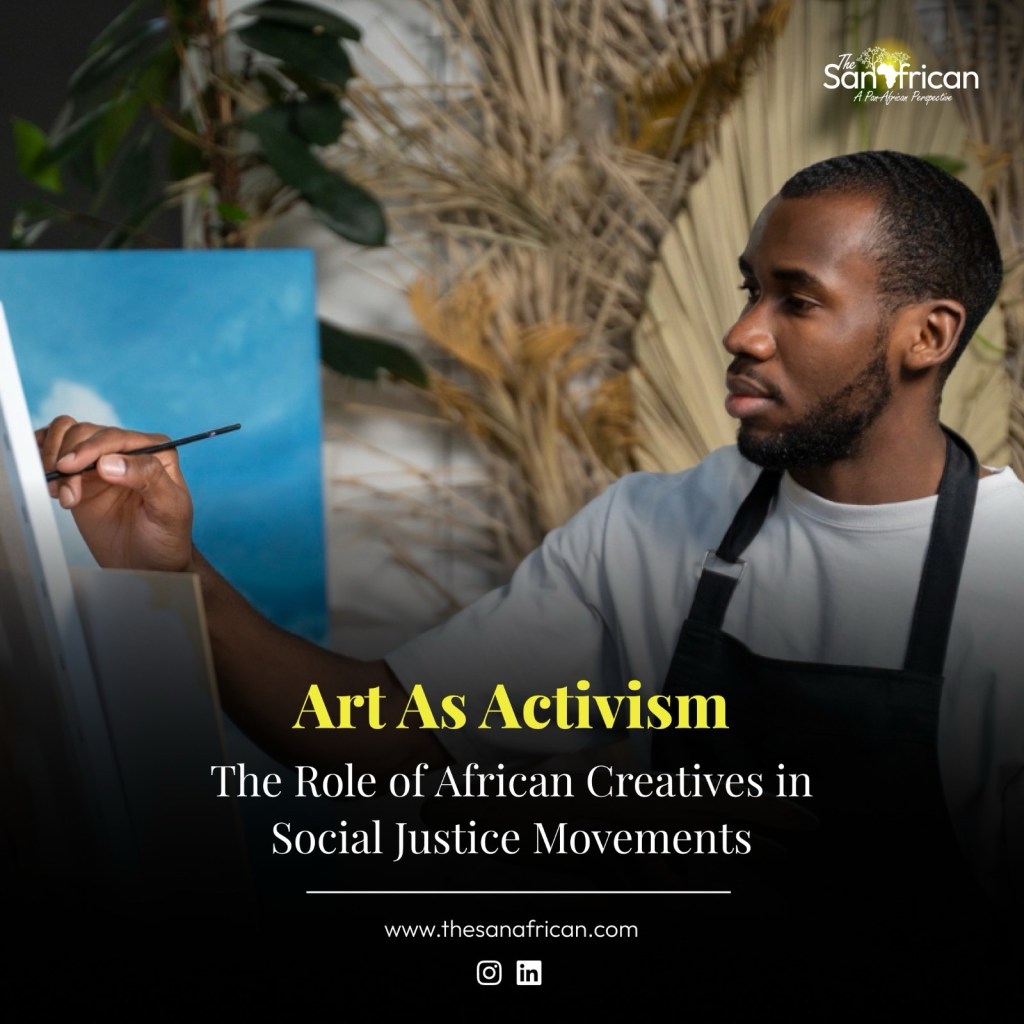
  • Art as Activism: The Role of African Creatives in Social Justice Movements

    Art as Activism: The Role of African Creatives in Social Justice Movements

    Though less respected than the sword, and less feared than the gun, the pen possesses an equally critical role in the emancipation of the African man. For every Nelson Mandela, there must be a William Kentridge, for every Steve Biko there should be a Yinka Shonibare and for every Patrice Lumumba, there will be a Wangechi Mutu. The role arts, culture and creatives as a whole have played in liberation movements across the African diaspora cannot be overstated. The most effective way to imprison ones mind is through the perpetuation of its inferiority through the media one consumes. A free Africa is an Africa that controls its own narrative, whether that be through the pen, paint brush or point chisel.

    Today we explore art as a weapon of emancipation and the role it has played in the rewriting of the African narrative; a central theme at the core of The San African identity. In doin so, we will take a look at 4 main aspects of Art as Activism.

    1. The Historical Roots of Art as Activism in Africa
    2. Key Artists and Movements that shaped Activist art
    3. The Modern forms of Artistic Expression in Social Movements
    4. The Impact of Art as a Catalyst for Change

    The Historical Roots of Art as Activism in Africa

    Art, in its most potent form, has always been a conduit for expressing the soul of a people. In pre-colonial Africa, artistic expression was not merely aesthetic but a living archive of culture, power, and resistance. Sculptures, masks, textiles, and oral traditions were imbued with spiritual and societal meaning, serving as both a reflection of communal values and an instrument of subtle defiance. Through these creative forms, African societies enshrined their collective memory, preserving traditions that silently resisted the erasure of their identity by foreign forces.

    With the onset of colonialism, the role of art as activism became even more pronounced. African artists and intellectuals confronted the cultural imperialism of European powers through movements like Negritude, which sought to reclaim the dignity of blackness in a world intent on its devaluation. Figures such as Léopold Sédar Senghor and Ben Enwonwu harnessed their talents to challenge colonial narratives, infusing their work with the vibrant essence of African identity that refused to be subdued. Their creations were silent yet resounding acts of defiance—reminding the colonized that art could be both a weapon and a shield.

    As the tide of independence swept across the continent, art surged to the forefront of political discourse. Nowhere was this more evident than in South Africa, where music, theater, and visual art became the lifeblood of the anti-apartheid struggle. The piercing trumpet of Hugh Masekela and the indomitable voice of Miriam Makeba became anthems of resistance, while theaters like Johannesburg’s Market Theatre transformed into arenas where the brutality of apartheid was laid bare. In their hands, art transcended mere protest; it became the embodiment of a people’s quest for freedom, an unflinching mirror held up to injustice.

    In the contemporary era, African artists continue to wield their creative power to confront the urgent challenges of our time. The vivid street art of Johannesburg, the poignant murals of Lagos, and the digital expressions echoing across the continent stand as testament to art’s undying role in activism. Whether highlighting the scourge of corruption, environmental degradation, or human rights abuses, artists are at the forefront of social movements like #EndSARS and FeesMustFall, reminding the world that the fight for justice and dignity is not waged with weapons alone, but with the unyielding force of creative expression.

    Throughout history, African art has been more than a mirror to the soul; it has been a clarion call to action, a profound testament to the resilience of a people whose voices, once silenced, now roar through the ages.

    Key Artists and Movements that shaped Activist Art.

     Corruption was one of the worst political problems facing Africa in the 1970s and Nigeria was among the most corrupt countries. Its government rigged elections and performed coups that ultimately worsened poverty, economic inequality, unemployment, and political instability, further promoting corruption and crime. Enter Fela Kuti. A Nigerian born musician and politcal activist hailed as being the founding father of Afrobeat as the genre we know it today.

    Kuti’s protest anthems echoed the harsh realities of corruption and socio-economic inequality that plagued the African continent. His music was not mere entertainment—it was a clarion call, a defiant voice that resonated across Africa, amplifying the political struggles and social injustices of his people. Through his uncompromising lyrics, Kuti transformed rhythm into rebellion, ensuring that his message reverberated far beyond Nigeria’s borders, stirring the consciousness of an entire continent.

    In the 1970s, Kuti circumvented Nigeria’s state-controlled media by using the advertising space in prominent newspapers like The Daily Times and The Punch to publish bold political columns. These outspoken writings, titled “Chief Priest Say”, ran throughout the 1970s and early 1980s, serving as an extension of his legendary Yabi Sessions—ritualistic, consciousness-raising performances at his Lagos nightclub, where Kuti, as the self-appointed chief priest, used his voice to challenge oppression and inspire resistance. Through these columns, he continued his unwavering mission to awaken the political consciousness of the people, undeterred by the censorship that dominated Nigeria’s press.

    Kuti’s writings placed special emphasis on the role of Cultural Hegemony in the continued oppression and dehumaization of Africans. The musician touched on a wide range of topics,  from fierce denunciations of the Nigerian Government’s criminal behavior, Islam and Christianity’s exploitative nature, and evil multinational corporations; to deconstructions of Western medicine, Black Muslims, sex, pollution, and poverty. “Chief Priest Say” was eventually canceled by The Daily Times and The Punch.

    Some of his most iconic songs featured heavy commentary on the political environment in ad around Nigeria during his time with songs like “Zombie” which gives a scathing critiqueof the Nigerian military, comparing soldiers to mindless zombies who obey commands without question. Songs like “Sorrows, Tears and Blood” feature a more gruesome insight into the violence and oppression in Nigeria and across the continent.

    Kuti is one example of an endless list of influetial creatives who towed the line when it came to artistic liberation. Artists like William Kentridge and El Anatsui as well as Zanele Muholi and Amilcar Cabral must be credited when it comes to the emancipation of the continent via their differet forms of art.

    Modern Forms of Artistic Expression in Social Movements

    In the vibrant tapestry of contemporary activism, art emerges as a dynamic and transformative force, deeply intertwined with the rhythm of social movements. Across Africa and the diaspora, modern forms of artistic expression harness innovative mediums to amplify voices, ignite change, and reimagine the possibilities of resistance.

    Digital Art and Social Media

    In today’s digital age, social media platforms like Instagram, Twitter, and TikTok have become crucial arenas for artistic activism. African artists leverage these spaces to craft and share powerful visual narratives, memes, and videos that resonate across borders. Movements such as #EndSARS in Nigeria and climate justice campaigns benefit from the rapid dissemination of art through hashtags and viral content. Virtual art exhibitions further extend this reach, offering global audiences an immersive experience that transcends physical boundaries, and fostering a connected dialogue around pressing issues.

    Street Art and Graffiti

    Street art and graffiti offer a bold canvas for political and social commentary, reflecting the pulse of grassroots movements. In cities from Lagos to Johannesburg, murals and street art serve as vibrant declarations against corruption, inequality, and systemic injustice. These public art forms, with their striking immediacy and ephemeral nature, engage communities directly and offer a subversive challenge to established power structures. The vivid murals commemorating the #FeesMustFall protests in South Africa and the evocative graffiti of Nairobi stand as testaments to the power of public art in shaping and reflecting social consciousness.

    Performance Art and Theater

    Performance art and theater have long been integral to African cultural expression, and they continue to play a vital role in modern activism. From the powerful narratives of Nigerian theater to the innovative performances of South African companies, these art forms dramatize social issues and evoke profound emotional responses. Companies like Theater for Change in Kenya and Market Theatre in Johannesburg use performance to confront political and social realities, transforming their stages into platforms for dialogue and resistance. Street theater, with its direct engagement of audiences, brings political statements into everyday spaces, making activism both accessible and impactful.

    Music and Film

    Music remains a potent vehicle for protest and social commentary across Africa and the diaspora. Artists from various genres, including Afrobeat, highlife, and hip-hop, channel their creativity to address pressing social issues. Fela Kuti’s legacy endures through contemporary artists who continue to use music as a form of resistance, from Burna Boy’s poignant tracks on social justice to the activism-driven melodies of Santi. Similarly, documentary and activist films spotlight critical issues, providing a lens into the struggles and triumphs of communities. Films like The Boy Who Harnessed the Wind and The Last King of Scotland illuminate African stories of resilience and challenge, fostering global awareness and empathy.

    Interactive and Participatory Art

    Interactive and participatory art projects empower communities to shape their own narratives and engage in collective resistance. Initiatives like the Mural Project in Accra, which brings together local artists and residents to create large-scale community murals, exemplify how art can foster unity and drive social change. Interactive installations that invite audience participation offer immersive experiences, deepening engagement with social issues and sparking meaningful dialogue.

    In the heart of Africa and the diaspora, modern artistic expressions are redefining the landscape of activism. By embracing new technologies and formats, contemporary artists continue to harness their creativity to challenge injustice, inspire collective action, and cultivate a global conversation rooted in the vibrant spirit of Afrocentric resistance.

    The Impact of Art as a Catalyst for Social Change

    Photogropher Zanele Muholi’s series “Faces and Phases” gives an insight into the lives of black members of the LGBTQ+ community in South Africa, sparking dialogue around the challenges they face and bringing visibility to marginalized communities in and around South Africa. Her striking potraits have brought attention to the discrimmination and violence against the aforementioned groups, aiding in the progress of dialogues and conversations about their rights and freedoms.

    Art has aided in the mobilization of communities (as demonstrated by Fela Kuti), raised awareness about serious social issues as in the works of Muholi and sparked conversations as seen in the art of Shepard Fairey.

    Creativity transcends aesthetic value and and acts as a catalyst for social and political change, fostering dialogue, raising critical issues and inspiring collective action. The art of a people is the talisman of their identity and those who maintain their maintain their identity cannot be killed in a way that matters.
  • The Leopard Question: A Renewal of the Trolley Problem and Ethical Imagination

    The Leopard Question: A Renewal of the Trolley Problem and Ethical Imagination

    Allow me to begin this article unceremoniously and ask a question: “If you see a leopard pursuing an antelope, are you moved to support the leopard in its pursuit of the antelope, or the antelope in its pursuit of freedom from the leopard?” (The operative phrase being “moved to”).

    I conducted a miniature research to find out how a few people think about ethics. The premise of the question is an inquisition of ethics and the moral purview of the human being (especially the African person).

    Many referenced a “natural order of things”. A supposed view that that which must happen will happen. The natural order subjects the antelope to the hunting prowess of the leopard, therefore the leopard deserves the trophy (in this case the meal).

    While this was an intriguing submission, I was particularly in awe of one that suggested that morality is a uniquely human invention.

    While I will not take a position on that particular assertion, I must admit that there is a sense that morality is particularly unique to humans. While nature may have a sense of “good and evil”, the intricacies of a codified set of rules is intriguingly human in its very essence.

    A question has been asked in the courts of philosophy – The Trolley Problem. Allow me to set the scene.

    A trolley (or train for those who may associate the word trolley with a shopping cart) races down a track. You realize that there are 5 people tied to the track who are awaiting their imminent and unfortunate demise. You notice that there is a lever that you can pull to redirect the trolley to a track with only one person.

    Some suggest that it is better for 1 to die than 5. Others suggest that pulling the lever is directly taking up responsibility for the death of the 1 person, while refusing to pull the lever was a refusal to take up any involvement and responsibility.

    Complicated? Let’s take it further. Let’s imagine that those 5 people are hardened criminals. Is it better for the 5 to die or the 1?

    Many other factors could be added to further complicate the question – age, gender, and more.

    The trolley problem is a question that exemplifies the innate complexity of ethics. While there are many branches, and even schools of thought, when we speak of ethics, we realize that ethics and morality are not innately simple to resolve.

    When introducing more factors to the trolley problem, we realize that the goal posts shift, because of various reasons. This does not make understanding ethics any easier.

    Returning to our initial question, The Leopard Question, there are three basic answers: (1) the antelope; (2) the leopard; (3) stay out of it.

    In attempting to understand these positions, we begin to see beyond the answer:

    (1) The Antelope – it seems that, especially in literary forms, it is often expressed that there is one who is innately vested with the brand of good and the observer is then moved to “save” this “good persona”.

    (2) The Leopard – the idea that the strong deserve to win. Those who are superior must come out as superior. This idea may be linked to a stratification, even of human beings, seeing some persons and person-groups being labeled as super-human, human, semi-human, or subhuman (with variations). This may even be linked to an imperial ideology.

    (3) Stay out of it – or “it’s none of my business”. As long as the leopard does not pursue me, it does not matter what happens – an apathetic stance. This view may be linked to the politico-apathetic stance of many, and the ignorance of many towards injustices (including social injustices).

    In considering ethics, it is crucial to recognize the role of cultural, historical, and social influences that shape our moral perspectives. What we deem “right” or “wrong” is often a reflection of our past, societal norms, and the environments in which we exist. This means that our moral frameworks are not only individual but also collective, owing their existence to centuries of philosophical, religious, and cultural development.

    Essentially, while this is not a paper on the analysis on the right form of ethics, this article seeks to ask a question: Is it possible that an ethic can stem from a problematic theoretical framework? Could it be that one’s ethical code could be informed by questionable elements?

    As an African, it is important to question if one’s ethics are informed by an anti-African imagination. It must be deemed possible that an African’s moral framework may be informed by a premise that seeks to undermine their very personhood. Therefore, it must be said that the exercise of the evaluation of individual and corporate ethics must be undertaken. How much of what we have as morality is informed by colonial influences, African cultural practices, neocolonial sentiments, or even critical analysis and synthesis? Do we truly understand, or we merely inherited our interpretation of what is good and evil?

    Fundamentally, this is not an investigation of ethics. This, I believe, must call the reader to look within themselves and ask the pertinent question: “Why do I believe what I believe?”